
Why Do We Carve Pumpkins? The 2,000-Year History Behind Halloween Traditions
Article by
Day of Today TeamWhy Do We Carve Pumpkins? The 2,000-Year History Behind Halloween Traditions
Our Halloween event page covers everything you need to know about what Halloween is, when it falls each year, and how to celebrate it — from costume parties and horror film marathons to haunted houses and trick-or-treating. But if you have ever wondered why we do these things — why we carve faces into vegetables, why children knock on doors demanding candy, why everything turns black and orange every October — read on. The answers stretch back more than 2,000 years, crossing Celtic bonfires, medieval churchyards, Irish immigrant ships, and American shopping malls.
Why Do We Carve Pumpkins?
The story of pumpkin carving begins not with pumpkins at all, but with turnips, potatoes, and beets — and it starts in Ireland.
During the 19th century, Irish families prepared for Halloween by hollowing out large turnips, carving grotesque faces into them, and placing a lit candle inside. These were called "jack-o'-lanterns" (from "Jack of the Lantern"), and they served a practical purpose: the glowing faces were placed in windows and doorways to frighten away evil spirits wandering the earth on the night of Samhain, the Celtic festival that marked the end of the harvest and the beginning of the dark half of the year.
The turnips were often carved with jagged, menacing features — sharp teeth, hollow eyes, twisted noses — designed to be as frightening as possible to anything lurking in the autumn darkness. An 1894 article in the Irish newspaper The Daily Telegraph described the tradition: "Youths and maidens carve faces on large turnips and place candles inside them, making what they call 'bogies' to terrify the unwary."
When Irish immigrants fled the Great Famine in the 1840s and 1850s, they brought this tradition to the United States. But they quickly discovered that turnips were small and hard to carve. Pumpkins, native to North America, were far larger, softer, and easier to work with — and they were abundant in the autumn months. The switch was immediate and permanent.
By the 1860s, carved pumpkins had become a standard feature of American Halloween celebrations. An 1866 article in the children's magazine Harper's Young People noted: "The pumpkin is the thing for Halloween. It is easier to carve than the turnip and makes a far more impressive lantern."
Today, the tradition is inseparable from Halloween in the United States, but its roots remain firmly planted in rural Irish cottages where frightened families once carved twisted faces into humble root vegetables to keep the darkness at bay.
Where Did Trick-or-Treating Come From?
The modern ritual of children dressing up and going door-to-door for candy has three distinct ancestors, each separated by centuries.
The first is the Celtic tradition of leaving food offerings. During Samhain, the Celts believed that the boundary between the living and the dead dissolved, allowing spirits to walk the earth. Families would leave food and drink on their doorsteps to appease these wandering spirits — not as a gift to neighbours, but as a supernatural bribe to keep ghosts from entering the home.
The second is the medieval practice of "souling." By the 9th century, the Catholic Church had transformed Samhain into All Saints' Day (November 1) and All Souls' Day (November 2). On All Souls' Day, poor people in England and Ireland would go door-to-door offering prayers for the household's dead relatives in exchange for food — typically small round cakes called "soul cakes." Each cake represented a soul freed from purgatory. The practice was widespread enough that William Wordsworth referenced it in a 1798 poem: "The sugar-plums are vanished, the soul-cakes are gone."
A related tradition was "guising" in Scotland and Ireland, where young people wore costumes and performed songs, jokes, or tricks at each door in exchange for fruit, nuts, or coins. The key difference from modern trick-or-treating was the performance requirement — you had to earn your treat.
The third ancestor is 20th-century America. Trick-or-treating as we know it — children in costumes collecting candy with no performance expected — did not appear until the late 1920s and early 1930s. The earliest known printed reference to the term "trick or treat" appeared in a 1927 edition of the Blackie Alberta Gazette in Canada. The practice spread across the United States during the 1930s and 1940s, though it was briefly interrupted by sugar rationing during World War II.
By the 1950s, trick-or-treating had become a universal American tradition, driven by post-war suburban growth and the baby boom. Candy companies seized the opportunity, and the small, individually wrapped candy bar — designed specifically for trick-or-treat distribution — became a multi-billion-dollar product category. Today, Americans spend roughly $3.6 billion on Halloween candy each year, rivaling the confectionery spending around National Candy Day and even approaching the scale of holiday shopping seen on Christmas Eve.
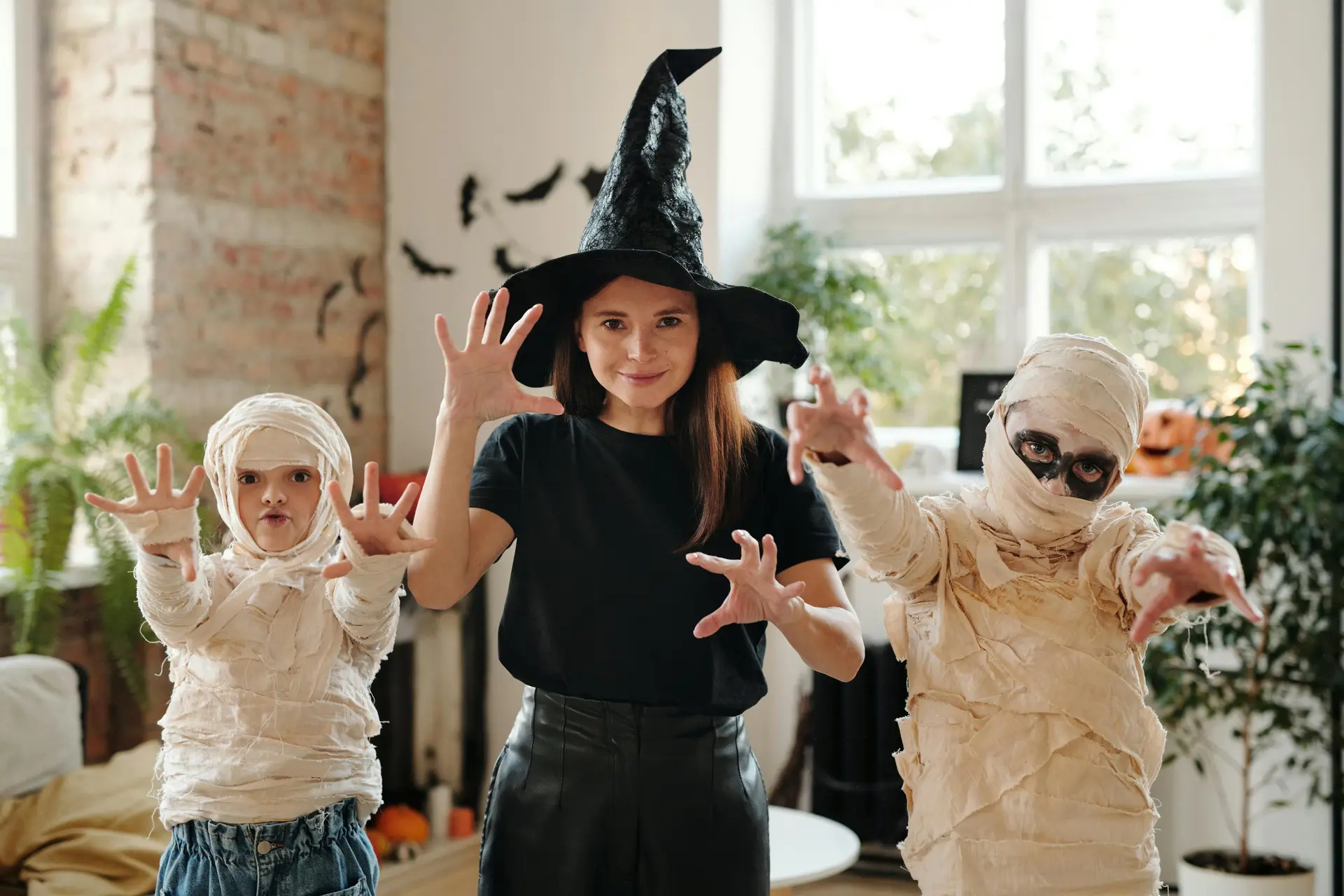
Why Do We Wear Costumes?
The answer begins, once again, with the ancient Celts — but the journey from animal-skin disguises to inflatable T-Rex suits is a long one.
During Samhain, the Celts believed that spirits of the dead returned to the mortal world on the night of October 31. Not all of these spirits were benign. To avoid being recognised by malicious entities, people would wear masks and animal skins as disguises. The logic was simple: if a vengeful spirit could not recognise you, it could not harm you.
This practice continued in various forms through the medieval period. In Scotland and Ireland, young men would dress in white sheets or blackened faces and go from house to house on Halloween night, often demanding food or coins — a practice directly linked to the "guising" tradition mentioned above.
Costumes remained homemade and folkloric well into the early 20th century. Children in the 1920s and 1930s typically wore simple ghost sheets, clown outfits, or costumes made from paper and cardboard. The first mass-produced Halloween costumes appeared in the 1930s, manufactured by companies like Ben Cooper, Inc. and the J. Halpern Company (better known as Halco). These early commercial costumes were made from cheap printed cotton or felt and came with a matching mask — often depicting pirates, witches, skeletons, and ghosts.
The 1950s and 1960s saw the explosion of licensed character costumes — children wanted to dress as Davy Crockett, Superman, and later, characters from Star Wars and Scooby-Doo. By the 1970s, the Halloween costume industry was a $300 million business.
Today, Halloween costume spending in the United States exceeds $4 billion annually. The most popular costumes cycle between classic archetypes (witches, vampires, ghosts) and pop-culture characters, with adults often outspending children — a trend that barely existed before the 1990s.
The Origins of Jack-o'-Lanterns: The Legend of Stingy Jack
Behind every carved pumpkin sits a cautionary tale about a man who outsmarted the Devil — and paid for it forever.
The legend of Stingy Jack is one of the oldest folktales in Irish mythology, dating back several centuries. The story exists in many versions, but the core narrative is consistent. Here is how it goes:
Jack was a notorious drunkard and a trickster who lived in a small Irish village. One evening, the Devil came to collect Jack's soul. Jack, thinking quickly, asked for one last drink before being dragged to Hell. The Devil agreed. When the bartender presented the bill, Jack convinced the Devil to turn himself into a silver coin to pay for the drink. The Devil did so — and Jack immediately snatched up the coin and slipped it into his pocket, next to a silver cross that prevented the Devil from changing back.
Jack struck a bargain: he would free the Devil if the Devil promised to leave him alone for ten years. The Devil, trapped, agreed.
Ten years later, the Devil returned. Jack asked for one last apple from a nearby tree. The Devil climbed the tree to fetch it, and Jack quickly carved a cross into the trunk, trapping the Devil in the branches. This time, Jack demanded that the Devil never take his soul. The Devil, humiliated, agreed.
When Jack finally died, he went to Heaven — but God refused him entry because of his sinful life. He went to Hell — but the Devil, bound by his promise, could not take him either. With nowhere to go, Jack was condemned to wander the earth for eternity. The Devil tossed him a single burning ember from Hell's fires to light his way. Jack placed the ember inside a hollowed-out turnip and has been roaming the world ever since — "Jack of the Lantern."
The tale was first recorded in written form in the mid-19th century by Irish folklorist T. Crofton Croker in his collection Fairy Legends and Traditions of the South of Ireland (1825), though oral versions are believed to be far older. Croker wrote that the jack-o'-lantern was known throughout Ireland as a "warning to avaricious souls" — a reminder that cleverness without morality earns you nothing but an eternity in the dark.
Irish families carved their own turnip lanterns both to ward off Jack's wandering spirit and to remind themselves of the moral of his story.
Why Black and Orange?
The colour palette of Halloween — black and orange — is so deeply ingrained that it feels instinctive. But like every Halloween tradition, it has specific historical roots.
Orange represents the Celtic harvest. Samhain was fundamentally an agricultural festival, marking the point when the last crops were brought in before winter. Orange symbolised the turning leaves, the ripe pumpkins and squash, the bonfires that burned on hilltops, and the autumn sun growing weaker. For a farming society, orange was the colour of survival — it meant the harvest was secure.
Black represents the darkness of winter — the long nights, the death of the growing season, and, most importantly, the spirits of the dead who were believed to walk freely on Samhain night. Black was the colour of the void that the Celts feared would consume the world if the sun continued to fade.
The pairing of orange and black was not a deliberate design choice — it was simply the dominant visual palette of late October in the Celtic world: dying orange foliage against the gathering black of early winter. When Halloween traditions migrated to America, the colours came along and were eventually codified by greeting card manufacturers and party supply companies in the early 20th century, who recognised the commercial value of a consistent brand identity.
How Haunted Houses Became Big Business
The commercial haunted house — a temporary walkthrough attraction designed to scare paying customers — is a relatively modern invention, and its origin can be traced to a single person and a single event.
In 1970, a man named Jim Stootman (often credited as the father of the commercial haunted attraction) organized what is widely regarded as the first charity haunted house in the United States. Held in Cincinnati, Ohio, the attraction was a small, volunteer-run event designed to raise money for a local cause. It was simple by today's standards — dark corridors, jump scares, actors in rubber masks — but it drew enormous crowds and proved that people would pay to be frightened.
The concept spread rapidly through the 1970s. Jaycee chapters, fire departments, and church groups across the country began building their own haunted houses as fundraising events. By the end of the decade, there were hundreds of amateur haunted attractions operating every October.
The 1980s saw the professionalisation of the industry. Haunted attractions grew larger, more elaborate, and more technologically sophisticated. The introduction of pneumatic props, Hollywood-quality makeup, and elaborate set design transformed haunted houses from community fundraisers into genuine entertainment destinations. The Haunted Attractions Association (now the Haunt Industry Association) was founded to support the growing trade.
By the 1990s, haunted houses had become a seasonal industry generating hundreds of millions of dollars. Today, the haunted attraction industry in the United States is estimated to be worth over $500 million annually, with more than 2,000 professional haunted attractions operating across the country. The largest — such as Netherworld in Georgia and ** Erebus** in Michigan — employ hundreds of actors and invest millions in production each year.
The industry has also spawned spin-offs: escape rooms with horror themes, extreme overnight experiences like the controversial McKamey Manor, and haunted hayrides and corn mazes that dominate rural entertainment every October.
Halloween by the Numbers
Statistic | Value | Source |
|---|---|---|
Total U.S. Halloween spending (2024) | $11.6 billion | National Retail Federation |
Candy spending | $3.6 billion | National Retail Federation |
Costume spending | $4.1 billion | National Retail Federation |
Decoration spending | $3.9 billion | National Retail Federation |
U.S. pumpkin production (2023) | 1.5 billion pounds | U.S. Department of Agriculture |
Average pumpkin price | $5.40 per pumpkin | USDA National Agricultural Statistics Service |
Trick-or-treat participants (U.S.) | ~41 million children | U.S. Census Bureau |
Top pumpkin-producing state | Illinois (650+ million lbs) | Illinois Department of Agriculture |
Haunted attractions in the U.S. | 2,000+ | Haunt Industry Association |
Haunted house industry revenue | $500+ million | Haunt Industry Association |
Halloween's rank by consumer spending | 2nd (behind Christmas) | National Retail Federation |
Candy corn produced annually | 35 million pounds | National Confectioners Association |
Sources
- History.com Editors. "History of Jack-o'-Lanterns." History.com, A&E Television Networks. — Detailed account of the Irish origins of carved vegetables and the Stingy Jack legend.
- "Samhain." Encyclopaedia Britannica. — Scholarly overview of the ancient Celtic festival that gave rise to modern Halloween.
- Rogers, Nicholas. Halloween: From Pagan Ritual to Party Night. Oxford University Press, 2002. — Comprehensive academic history tracing Halloween from its Celtic origins through its American commercialisation.
- Skal, David J. Death Makes a Holiday: A Cultural History of Halloween. Bloomsbury, 2002. — Cultural analysis of Halloween traditions including trick-or-treating, costumes, and haunted attractions.
- National Retail Federation. "Halloween Spending Survey." nrf.com. — Annual consumer spending data on costumes, candy, and decorations.
Article by
Day of Today TeamThe editorial team behind Day of Today, researching and writing about the world's most interesting holidays and celebrations.